The AI landscape is continually evolving, and the recent release of MLPerf Inference v3.1 highlights this progress with the introduction of pioneering benchmarks in large language models (LLMs) and recommendation systems. This iteration has seen a remarkable surge in participation, amassing over 13,500 performance results with performance enhancements reaching up to 40 percent.
A diverse array of industry leaders, with 26 unique submitters and over 2,000 power results, underscores the extensive investment in AI technologies. Major tech companies like Google, Intel, and NVIDIA, alongside emerging players such as Connect Tech, Nutanix, and Oracle, have made submissions, showcasing a broad commitment to advancing AI solutions.
David Kanter, Executive Director of MLCommons, emphasized the complexity and importance of participating in MLPerf benchmarks, describing the submissions as labor-intensive, genuine engineering efforts which highlight the dedication of these participants to innovation and customer solutions.
MLPerf Inference is a quintessential benchmark suite that evaluates how efficiently AI systems can perform model execution across a variety of deployment scenarios, from next-gen AI chatbots to advanced safety features in vehicles like lane-keeping and speech recognition.
A central focus of MLPerf Inference v3.1 is its new benchmarks, including:
- An LLM using the GPT-J model, generating summaries of CNN news articles, which drew participation from 15 entrants—a testament to the fast-growing field of generative AI.
- An enhanced recommendation benchmark incorporating the DLRM-DCNv2 model with larger datasets, aligning closely with modern industry practices and attracting nine distinct submissions.
These benchmarks are tailored to extend the limits of AI standardizations, offering crucial insights to customers, vendors, and researchers navigating the evolving AI landscape.
As per Mitchelle Rasquinha, co-chair of the MLPerf Inference Working Group, the latest submissions reflect a wide spectrum of accelerators designed to meet diverse ML workload needs. The introduction of the GPT-J model amplifies AI's role in the generative space, providing valuable data for users selecting appropriate accelerators across different domains.
The suite emphasizes datacenter and edge computing systems, showcasing a diverse range of processors and accelerators handling tasks in computer vision, recommendation engines, and language processing. Open and closed submissions foster a competitive and equitable environment, leveraging standard models to ensure fairness while permitting varied model submissions in the open division.
Ultimately, with AI's growing influence across all sectors, MLPerf benchmarks are indispensable for assessing and steering the future of AI-driven technologies, including the exciting realm of AI visual transformations.
Stepping into the realm of this advanced AI domain opens intriguing discussions on how these capabilities influence visually transformative technology.
The Future of AI in Video Content Creation
We’re living in a time when video content dominates the digital landscape. Whether you're building a brand, growing a following, or just sharing your creativity with the world, compelling visuals are essential to capturing attention. But let’s be real—traditional video production can be a grind. It takes time, money, and often a whole team of experts.
That’s exactly where AI is changing the game.
New-generation AI tools like Dreamlux are making it easier than ever to bring ideas to life. From turning simple text prompts into full-blown animations, to generating voiceovers and smooth transitions automatically, AI video generators are putting high-quality content creation within reach for everyone—not just professionals.
And just when you think it couldn’t get more impressive—AI takes another bold step forward.
Enter the World of AI Muscle Generators
Among the many innovations in AI-driven video creation, AI Muscle Generators are carving out their own unique space. These tools use powerful generative algorithms to add or enhance muscular features on characters—based on user-provided images or text prompts.
Whether you're creating dynamic characters for fitness content, gaming avatars, comic book-style heroes, or stylized animation, AI muscle generators offer a fun and visually striking way to bring bold physiques to life. Imagine transforming an ordinary image into a high-definition, muscle-enhanced version—complete with definition, symmetry, and cinematic lighting—all with just a few clicks.
From saving time on digital sculpting to opening up new creative possibilities, AI continues to shape the future of video content—one flex at a time.
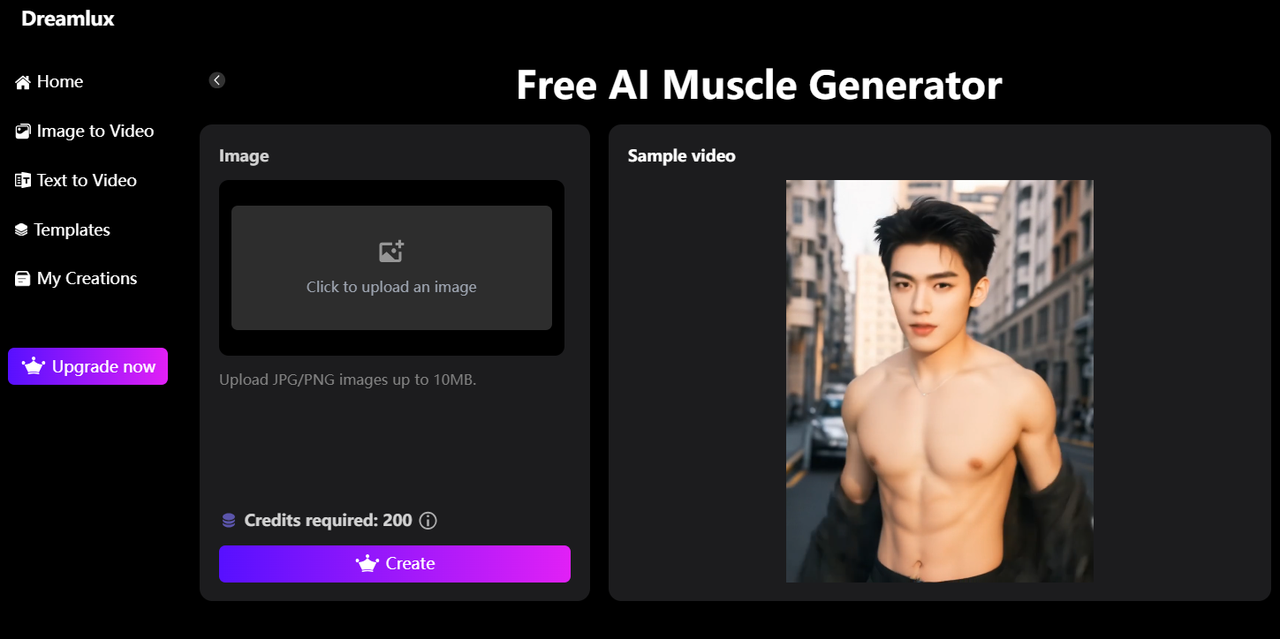
How to use Dreamlux to generate an AI Muscle Video?
Follow the steps to use the AI Muscle Generator at Dreamlux.ai:
- Go to Dreamlux.ai and select "Templates"
- Select "Free AI Muscle Generator"
- Upload an image of the people or character you want to generate an AI Muscle Video for.
- Click "Create" and let our AI Muscle Generator bring your vision to life